
Boundary Survey Issues That Can Delay a Home Addition Permit
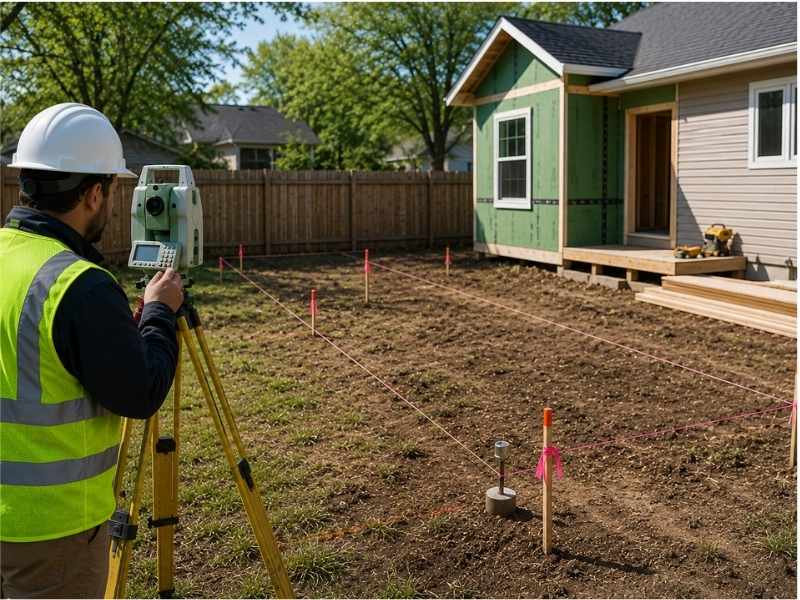
A home addition permit can stall for reasons that have nothing to do with the addition itself. A boundary survey issue can hold up approval for weeks. Often the homeowner never even knew there was a problem.
Why an Old Boundary Survey May Cause Permit Delays
Many homeowners have a survey on file from when they bought the house, sometimes decades old. It was accurate for its time. But a permit office looking at a new addition needs to know exactly where the lines sit today.
Older surveys often lack details that building departments now expect. Standards change. Equipment improves. An old plat may not show the precision a modern review requires.
When a permit office cannot check the boundary details it needs, the request goes back to the homeowner. That means ordering a new survey. It adds time to a project that was already on a schedule.
How Missing Property Markers Can Create Boundary Survey Problems
Property markers are small but important. These metal pins or concrete monuments mark the exact corners of a lot. A surveyor uses them to establish where the boundary actually runs.
When a marker is missing or damaged, locating the line takes more work. A surveyor has to rely on other records and measurements. There’s no quick check against a marker in the ground.
That extra work takes extra time. A permit office waiting on a completed survey will not move forward until the boundary is verified. A project that could have cleared review in days ends up waiting while the survey digs deeper than planned.
How a Boundary Survey Helps Homeowners Follow Setback Rules
Setback rules set the minimum distance a structure can sit from a property line. These rules protect access for utilities and emergency equipment. They also keep enough space between neighboring structures.
A boundary survey gives a homeowner the verified line that setback rules actually measure from. Without it, a builder is working from a guess. A guess that’s off by even a foot can put an addition too close to the line.
Permit offices check this distance carefully before approving an addition. An accurate survey lets a builder design the addition correctly from the start. That beats submitting a plan that gets sent back for a setback problem.
Why Floodplain Rules Can Affect a Boundary Survey Review
Some properties sit in areas with extra building rules tied to flood risk. These rules exist to reduce flood damage and protect future construction. A permit office reviewing the addition needs to see how it sits next to both the property line and the floodplain boundary.
A boundary survey becomes more important here, not less. The same survey that checks the property line can also show how the addition sits next to the floodplain boundary. The permit office needs both pieces to finish its review.
Skipping this step or relying on outdated information can send an application back for clarification. A permit reviewer needs both lines settled at the same time. Checking both together keeps the review moving instead of stalling on a missing detail.
How a Boundary Survey Helps Avoid Problems After Work Begins
A permit approval is not the finish line. Once construction starts, the same boundary information that got the project approved keeps it on track. The line that mattered on paper still matters once crews show up.
Knowing the correct property line before the first shovel goes into the ground prevents a costly scenario. A foundation or wall built too close to the line might go unnoticed until concrete is already in place. Fixing that mistake after work begins costs far more than checking the line beforehand.
A boundary survey done early gives a builder one less thing to second guess. The crew can focus on building the addition. They don’t have to stop mid project to check something the permit process should have already settled.
Frequently Asked Questions
Why do cities ask for a boundary survey before approving a home addition?
A permit office needs to confirm where the property lines sit before approving new construction. The review depends on knowing where the addition can legally go.
How can missing property markers affect a boundary survey?
When markers are missing, a surveyor needs more time to establish the boundary through other records. That extra work can delay the survey a permit office is waiting on.
What are setback rules, and how does a boundary survey help with them?
Setback rules set the minimum distance between a structure and the property line. A boundary survey gives the exact line those distances are measured from.
Why do floodplain requirements matter when planning a home addition?
A floodplain boundary adds another line a permit office needs to see alongside the property line. The survey has to account for both before the review can move forward.
How can a boundary survey help prevent construction delays?
Confirming the property line before work begins avoids a costly correction. A structure built too close to a boundary nobody checked in advance costs far more to fix later.